I’ve been a huge fan of Merlin Mann ever since I got into Getting Things Done and stumbled onto his web site 43Folders. Yesterday Merlin posted one of his missivies on productivity that is an instant classic and it reminds me why I continue to read his web site. In his article Mud Rooms, Red […]
Tag / productivity
Getting Things Done: The Art of Stress-Free Productivity by David Allen
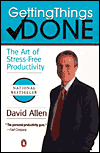
There’s an old Louisiana saying, ‘When you’re up to your ass in alligators is when you remember you were supposed to drain the swamp.’ 2002 was my year of the alligator and luckily Tony Ching of the San Francisco Palm Users Group recommended this book to me. What struck me by his recommendation was not the level of excitement he had about the book (like my excitement over The E-Myth Revisited), but rather the Zen like calm he had when discussing it.
David Allen is president of David Allen & Co. and has more than twenty years’ experience as a management consultant, executive coach, and educator. He has been a keynote speaker and productivity facilitator for organizations such as Oracle, L. L. Bean, Microsoft, Lockheed, and the World Bank.His work has been featured in Fast Company, Fortune, and many other publications. With a background like that I was really expecting a dry and very business like book. However, in the first chapter he referrs to “flow,” and to reach a state where your mental state is a “mind like water,” I knew that this was going to be a different kind of book. That is not to say that just because you throw in a few Eastern philosophies you have a good book. Obviously, you have to have real-world solutions and not just another collection of buzz words and this book delivers. The premise of the book is that you have to have a system that works irregardless of what technology you use. In other words, a new piece of software, or a new type of binder isn’t going to do it. You need a fool-proof system that can adapt as you need to.